Building the Neural Mesh: Technical Deep Dive
An inside look at the engineering challenges and breakthroughs behind Technozlife's neural mesh technology.

Mike Rodriguez
Principal Engineer
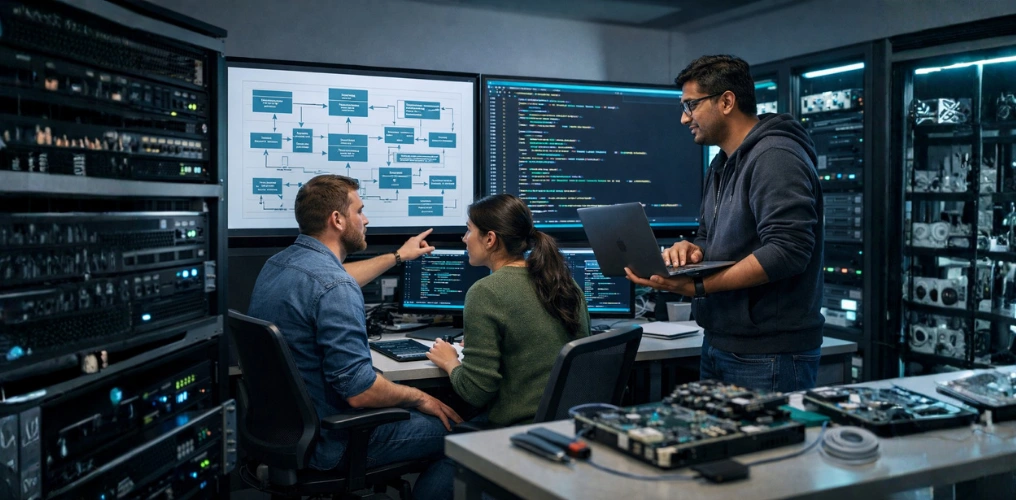
Engineering the Interface
Creating a seamless connection between biological and digital systems is one of the greatest engineering challenges of our time. Here's how we're approaching it.
The Neural Mesh Architecture
Our neural mesh consists of several key components:
- Biocompatible Substrate: Ultra-thin polymer mesh that integrates with neural tissue
- Nanoscale Electrodes: Thousands of recording and stimulation points
- Wireless Power & Data: No physical connections through the skin
- Edge Processing: On-device AI for real-time signal interpretation
Signal Processing Challenges
The brain produces incredibly complex signals:
- Noise: Biological systems are inherently noisy
- Scale: Millions of neurons, billions of synapses
- Dynamics: Neural patterns change constantly
- Individuality: Every brain is unique
Our Solutions
We've developed novel approaches to each challenge:
Adaptive Filtering
Our AI learns each user's unique neural signature,
continuously adapting to optimize signal quality.
Distributed Computing
Processing happens both on-device and in the cloud, balancing latency and capability.
Personalization Engine
Machine learning models are fine-tuned to each individual's neural patterns.
Safety First
Safety is non-negotiable:
"We don't ship until we're confident. Lives depend on getting this right." - Engineering Maxim
Our safety protocols include:
- Triple-redundant shutdown systems
- Continuous monitoring for anomalies
- Biocompatibility testing exceeding FDA requirements
- Long-term implant studies
The Road Ahead
Current neural meshes are remarkable, but they're just the beginning. Future generations will feature:
- Higher electrode density for finer control
- Bidirectional communication with individual neurons
- Self-healing materials that grow with neural tissue
- Integration with next-gen AI for true cognitive partnership
Written by
Mike Rodriguez
Principal Engineer
Dedicated to pushing the boundaries of what's possible at the intersection of humanity and technology.